


Let’s be honest nobody talks like a textbook in real life.
You don’t say, “I am extremely fatigued.” You say, “I’m dead tired.” That’s a colloquialism.
Colloquial expressions are everywhere—in conversations, social media, movies, and even marketing copy. But here’s the catch: what sounds natural in speech can completely ruin your academic writing if used carelessly.
In this guide, you’ll learn:
- 50+ colloquialism examples with meanings
- When to use them (and when not to)
- How to replace them in formal writing
By the end, you’ll know exactly how to sound natural without sounding unprofessional.
Table of Contents
- What is a Colloquialism?
- Colloquialism vs Slang vs Idioms
- 50+ Colloquialism Examples with Meanings
- When to Use Colloquial Language
- When to Avoid It in Academic Writing
- Formal Alternatives to Colloquialism
- How to Use Them Effectively
- FAQs
What is a Colloquialism?
A colloquialism is an informal word or phrase commonly used in everyday conversation rather than formal writing.
Think of it as “real-life language.”
Examples:
- “Gonna” instead of “going to”
- “Hang out” instead of “spend time together”
- “Piece of cake” instead of “very easy”
Here’s the reality—people connect with casual language faster. It feels human. But that doesn’t mean it belongs everywhere.
Colloquialism vs Slang vs Idioms
Most people mix these up. Let’s fix that quickly.
Colloquialism
- Everyday informal language
- Widely understood
- Example: “What’s up?”
Slang
- Trendy, often short-lived
- Limited to specific groups
- Example: “That’s lit”
Idioms
- Figurative expressions
- Meaning not literal
- Example: “Break the ice”
Simple way to remember:
- Colloquial = casual
- Slang = trendy
- Idiom = metaphorical
Get a high-quality essay written for you submit your requirements now.
50+ Colloquialism Examples with Meanings
Let’s break this into categories so it actually sticks.
Everyday Expressions
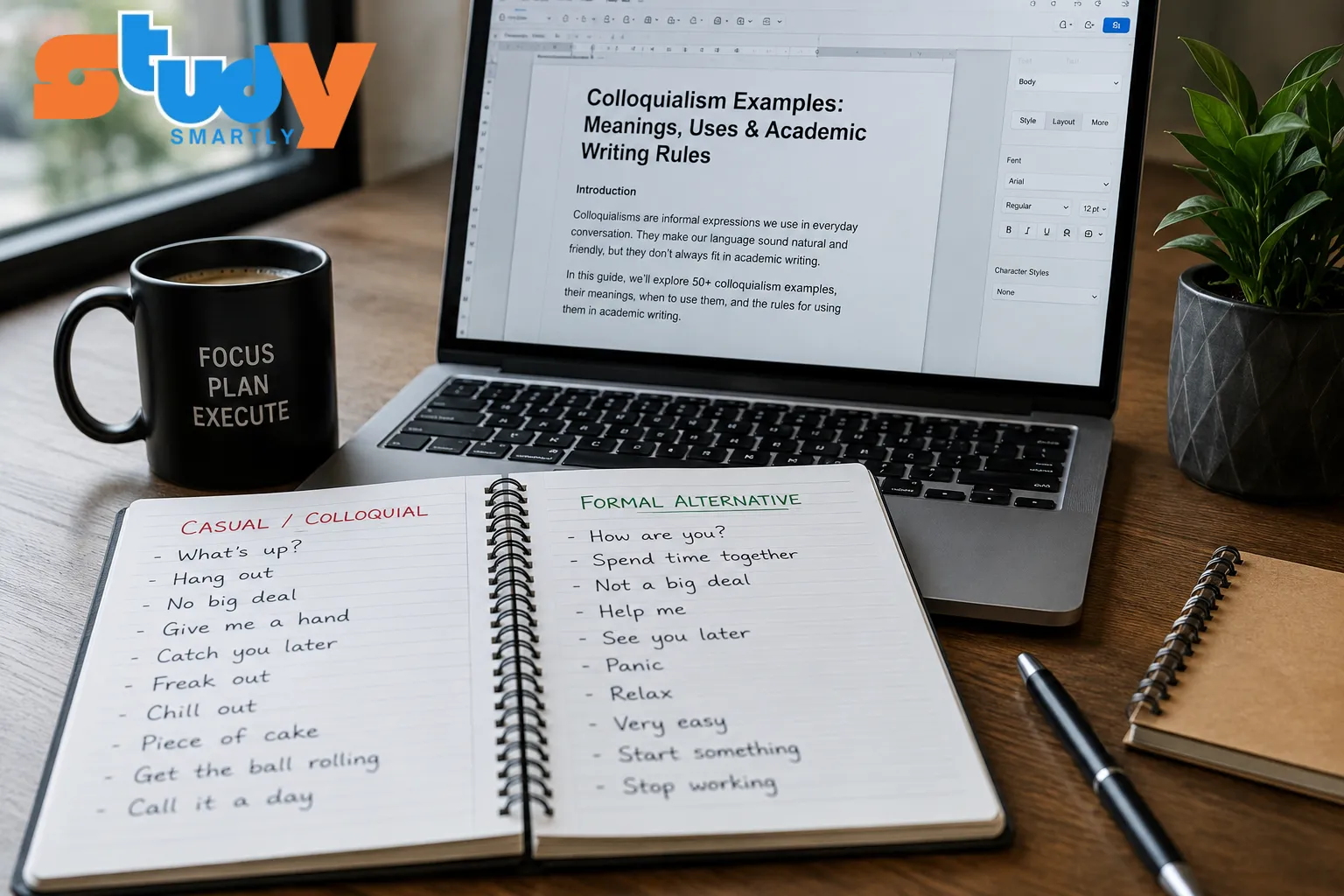
- “What’s up?” – How are you?
- “No big deal” – Not important
- “Hang on” – Wait
- “Give me a hand” – Help me
- “Catch you later” – See you later
Time & Effort
- “In no time” – Very quickly
- “All day long” – Continuously
- “Last minute” – Just before deadline
- “Back in the day” – In the past
Emotions & Reactions
- “Freak out” – Panic
- “Chill out” – Relax
- “Over the moon” – Very happy
- “Bummed out” – Disappointed
Work & Productivity
- “Get the ball rolling” – Start something
- “Pull your weight” – Do your part
- “Call it a day” – Stop working
- “On the same page” – Agree
More Colloquialism Examples
Difficulty & Simplicity
- “Piece of cake” – Very easy
- “Hard nut to crack” – Difficult problem
- “No sweat” – Easy
Money & Value
- “Break the bank” – Very expensive
- “Dirt cheap” – Very cheap
- “Worth every penny” – Valuable
Social Situations
- “Hit it off” – Get along quickly
- “Hang out” – Spend time together
- “Drop by” – Visit casually
Random Everyday Talk
- “Stuff” – Things
- “Kinda” – Kind of
- “Sorta” – Sort of
- “Y’all” – You all
Now here’s where people mess up—they start using these in essays or formal reports. That’s a mistake.
Struggling with academic or professional writing? Learn how to transform casual language into polished, high-ranking content.
When to Use Colloquial Language
Colloquialism works best when your goal is connection.
Use it in:
- Blog posts
- Social media content
- Emails (informal)
- Marketing copy
- Storytelling
If you want your audience to feel like you’re talking to them—not at them—this is your tool.
Let’s be real. A blog that sounds like a legal document? Nobody finishes it.
When to Avoid Colloquialism in Academic Writing
This is where discipline matters.
Avoid colloquialism in:
- Academic essays
- Research papers
- Business reports
- Formal presentations
Why?
Because it:
- Reduces credibility
- Sounds unprofessional
- Weakens clarity
Example:
“The results were kinda surprising”
“The results were somewhat unexpected”
That small change? Huge difference in perception.
Polish your essay to perfection get expert editing today.
Formal Alternatives to Colloquialism
Let’s upgrade your language.
| Colloquial | Formal Alternative |
|---|---|
| Gonna | Going to |
| Wanna | Want to |
| A lot | Numerous |
| Kids | Children |
| Stuff | Items / Materials |
| Big deal | Significant |
| Get | Obtain |
| Fix | Repair |
| Try | Attempt |
| Deal with | Address |
Quick rule:
If it sounds like a conversation, double-check before using it in formal writing.
How to Use Colloquialism Effectively
Here’s the strategy most people miss.
1. Know Your Audience
Writing for students? Casual works.
Writing for professors? Keep it formal.
2. Mix, Don’t Overuse
Too much informal language makes you sound careless.
3. Use It for Flow
Colloquial phrases can break monotony and improve readability.
4. Avoid Ambiguity
Some phrases don’t translate well across cultures.
5. Edit Ruthlessly
Write casually if needed—but refine before publishing.
Think of it like this:
Write human. Edit smart.
Conclusion
Colloquialism isn’t the enemy. Misusing it is.
You now have:
- 50+ colloquialism examples
- Clear rules on when to use them
- Formal alternatives for academic writing
Use casual language to connect. Use formal language to impress.
The real skill? Knowing when to switch.
Impress top business schools — order your MBA essay now.
FAQs
What is a colloquialism in simple terms?
A colloquialism is an informal word or phrase used in everyday conversation.
Are colloquialisms the same as slang?
No. Colloquialisms are widely used, while slang is more specific and often temporary.
Can I use colloquial language in essays?
Generally, no. Academic writing requires formal language.
Why are colloquialisms important?
They make communication more natural and relatable.
How do I avoid colloquialism in writing?
Replace informal phrases with formal alternatives and review your tone carefully.