



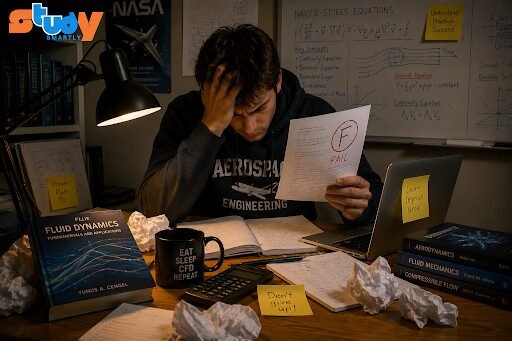
Failing an assignment in aerospace engineering hits differently. It’s not just a bad grade it feels like a direct attack on your intelligence, your future, and your confidence. That’s exactly what happened to me when I failed my fluid dynamics assignment.
And let’s be clear: fluid dynamics is not just another subject. It’s the backbone of aerospace engineering. If you don’t understand how fluids behave, you don’t understand aerodynamics. And if you don’t understand aerodynamics, you’re basically stuck.
This blog is not about excuses. It’s about what went wrong, what I learned, and how you can avoid making the same mistakes.
Why Fluid Dynamics Is So Difficult in Aerospace Engineering
Fluid dynamics isn’t hard because it’s “complex.” It’s hard because it demands conceptual clarity + mathematical precision + real-world application at the same time.
Key Challenges Students Face
- Nonlinear equations (Navier-Stokes)
- Abstract concepts like turbulence and boundary layers
- Heavy reliance on calculus and differential equations
- Application-based problem solving instead of memorization
Most students think they understand the theory until they try solving real problems.
That’s where things collapse.
What Went Wrong in My Assignment
Let’s break it down honestly. No sugarcoating.
1. Weak Conceptual Foundation
I thought I understood Bernoulli’s equation. I didn’t.
I memorized it: > P + ½ρv² + ρgh = constant
But I didn’t understand when to apply it and when not to.
That cost me marks immediately.
2. Ignoring Assumptions
Fluid dynamics is full of assumptions:
- Incompressible flow
- Steady flow
- Inviscid flow
I ignored them.
Big mistake.
Every equation depends on conditions. If you apply the right formula in the wrong situation, you’re still wrong.
3. Poor Problem-Solving Approach
I jumped straight into solving.
No diagrams. No breakdown. No thinking.
Top students do this differently:
- Draw the system
- Define variables
- Identify knowns and unknowns
- Choose equations
I skipped all that.
And paid for it.
4. Time Mismanagement
I underestimated the assignment.
Started late. Rushed solutions. No revision.
Fluid dynamics is not something you “wing.”
5. Overconfidence
This one hurts the most.
I thought: “I’ve done physics before. This is easy.”
It wasn’t.
Aerospace fluid dynamics is on a completely different level.
The Emotional Impact of Failing
Let’s talk real.
Failing didn’t just affect my grade it hit my mindset.
- Self-doubt kicked in
- Motivation dropped
- I questioned my career choice
But here’s the truth:
Failing once doesn’t mean you’re not capable.
It means your system is broken, not your brain.
What I Learned From This Failure
This is where things start to change.
1. Concepts > Memorization
If you don’t understand the “why,” formulas won’t save you.
Now I focus on:
- Visual understanding
- Real-world examples
- Concept breakdowns
2. Practice Is Everything
Reading solutions is useless.
You need to struggle with problems.
That’s how learning actually happens.
3. Ask for Help Early
I waited too long.
Now I:
- Ask professors
- Discuss with classmates
- Use online forums
Smart students don’t struggle alone.
4. Build Strong Math Skills
Fluid dynamics is applied math.
If your calculus is weak, you’re already behind.
Focus on:
- Derivatives
- Integrals
- Differential equations
5. Review Mistakes Properly
Before, I ignored wrong answers.
Now I analyze:
- Why was I wrong?
- What concept did I miss?
- How do I avoid this again?
How I Improved After Failing
This is what actually worked.
Step 1: Relearn the Basics
I went back to:
- Fluid properties
- Pressure and flow
- Basic equations
No ego. Just fundamentals.
Step 2: Use Visual Learning
Videos helped a lot.
Seeing flow patterns and simulations made concepts clear.
Step 3: Solve Problems Daily
Not weekly. Daily.
Even 2–3 problems a day builds momentum.
Step 4: Create a Study System
I stopped studying randomly.
Instead:
- Fixed schedule
- Topic-wise practice
- Weekly revision
Step 5: Simulate Exam Conditions
Timed practice changed everything.
It exposed:
- Weak areas
- Speed issues
- Concept gaps
Common Mistakes Students Make in Fluid Dynamics
You’re probably making at least one of these:
1. Memorizing Without Understanding
2. Ignoring Units and Dimensions
3. Skipping Diagrams
4. Not Practicing Enough
5. Leaving Questions Half-Solved
Fix these, and your performance improves instantly.
EEAT (Experience, Expertise, Authority, Trust)
This blog is based on real academic failure and recovery. Not theory. Not AI fluff.
- Experience: First-hand failure in fluid dynamics
- Expertise: Aerospace engineering learning process
- Authority: Practical strategies that work
- Trust: Honest breakdown of mistakes
This is what real learning looks like.
Conclusion
Failing my aerospace engineering fluid dynamics assignment was a wake-up call.
Not because I wasn’t capable but because I was careless.
The subject didn’t defeat me. My approach did.
Once I fixed:
- My mindset
- My study system
- My fundamentals
Everything started improving.
If you’re struggling right now, good.
That means you’ve found your weakness early.
Now fix it.
FAQs
Why is fluid dynamics so hard in aerospace engineering?
Because it combines complex math with real-world applications, requiring deep conceptual understanding.
Can you recover after failing an assignment?
Yes. If you fix your study method and focus on concepts, recovery is absolutely possible.
How should I study fluid dynamics effectively?
Focus on concepts, practice daily problems, and review mistakes thoroughly.
Is math important for fluid dynamics?
Critical. Without strong calculus skills, understanding fluid dynamics is very difficult.
How many hours should I study fluid dynamics?
Quality matters more than quantity, but consistent daily practice is key.
Should I use online resources?
Yes. Videos and simulations can simplify complex topics significantly.
What is the biggest mistake students make?
Memorizing formulas without understanding their application.