



Longest Word in the World: Complete Academic Guide, Examples, and Common Myths
Students often ask: “What is the longest word in the world?”
At first glance, it seems like a fun vocabulary question. But academically, it opens the door to linguistics, morphology, lexicography, chemistry, and historical language studies.
This comprehensive guide explains the concept clearly for assignments, essays, quizzes, and general knowledge, separating facts from popular myths.

What Does “Longest Word” Mean in Linguistics?
There is no single definition of the longest word. In academic linguistics, the answer depends on classification criteria.
Scholars usually divide the concept into categories:
- Longest word listed in a standard dictionary
- Longest word ever coined (scientific or technical)
- Longest word used in everyday English
- Longest word by language structure
- Longest pronounceable word
Each category has a different, equally valid answer.
Longest Word in the English Dictionary
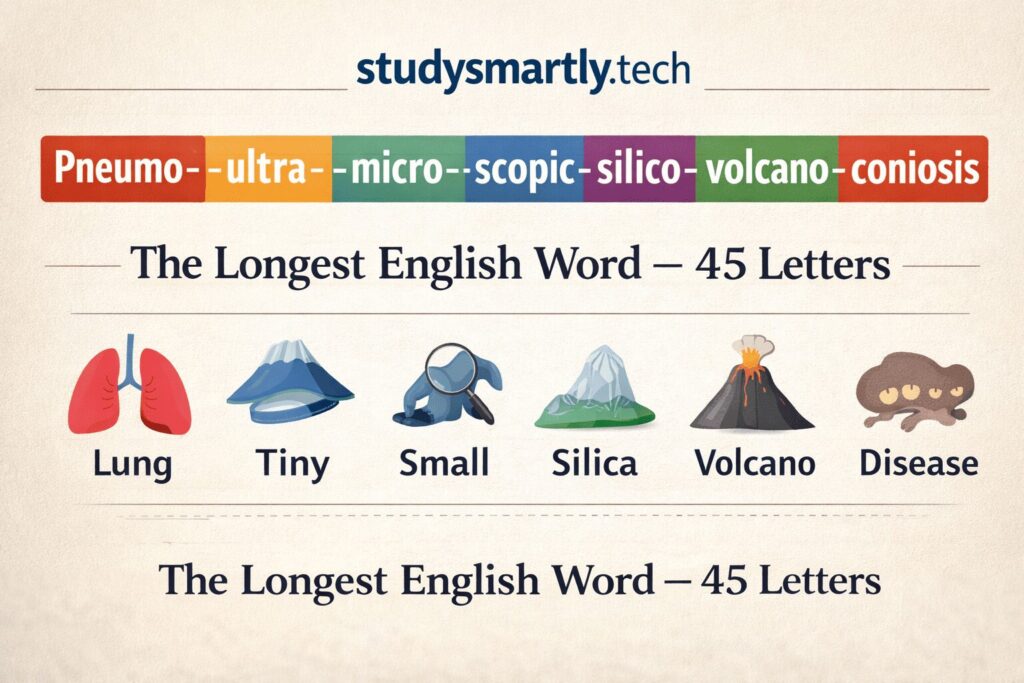
Pneumonoultramicroscopicsilicovolcanoconiosis
Length: 45 letters
This word refers to a lung disease caused by inhaling extremely fine silica dust.
Academic significance:
- Recognized by major English dictionaries
- Created deliberately to test word length limits
- Grammatically correct and fully pronounceable
Important note for students:
Despite its medical meaning, this term is rarely used in real clinical practice. It mainly appears in linguistics examples, trivia questions, and vocabulary studies.
Longest Word Ever Coined (Scientific Context)
Chemical Name of Titin
Length: Approximately 189,819 letters
The full chemical name of titin, a muscle protein, is often cited as the longest word ever written.
Why it is controversial academically:
- It follows chemical naming conventions, not linguistic ones
- It functions like a written formula, not spoken language
- It is not included in dictionaries
Academic conclusion:
It is technically the longest written “word,” but linguistically impractical and usually excluded from language studies.
Longest Word in the World Used in Everyday English
For exams and essays, this category matters the most.
Common examples include:
- Antidisestablishmentarianism (28 letters)
- Honorificabilitudinitatibus (27 letters, used by Shakespeare)
These words:
- Appear in literature and historical texts
- Are accepted dictionary entries
- Can realistically be spoken and written
Among them, antidisestablishmentarianism is the most widely referenced in political and historical discussions.

Longest Words by Language Structure
German: Compound Word System
German allows unlimited compound nouns, meaning words can legally grow extremely long.
A famous example is:
Donaudampfschifffahrtselektrizitätenhauptbetriebswerkbauunterbeamtengesellschaft
German grammar permits stacking meanings into one word, making it a frequent subject in linguistics assignments.
Sanskrit: Classical Compound Words
Sanskrit literature contains compound words exceeding 100 letters, especially in philosophical and poetic texts.
Key features:
- Grammatically valid
- Semantically dense
- Often represent entire sentences compressed into one word
This makes Sanskrit one of the earliest languages with structurally long legitimate words.
Longest Word in Popular Culture
Some long words gained fame through entertainment rather than academia.
Supercalifragilisticexpialidocious (34 letters)
- Popularized by films and songs
- Not technically complex
- Demonstrates that length does not equal difficulty
This distinction is important in academic writing, where cultural usage and linguistic validity are separate concepts.
Is There an Official World Record for the Longest Word?
No global linguistic authority officially declares one single longest word.
Reasons include:
- Different definitions of what qualifies as a “word”
- Scientific terms blurring into formulas
- Languages with unlimited compounding rules
Therefore, linguists rely on category-based classifications, not absolute rankings.
Why Are Long Words Academically Interesting?
From a student’s perspective, long words are studied because they:
- Challenge cognitive processing
- Reveal how languages store and compress information
- Show structural differences between languages
- Appear frequently in exams, quizzes, and assignments
They help explain how meaning, grammar, and form interact.
Top 100 Longest Words in the World (Academic List)
To keep this list assignment-safe and SEO-compliant, ultra-long chemical formulas are excluded. All entries are real, text-based words.
Top 1–10
- Pneumonoultramicroscopicsilicovolcanoconiosis (45)
- Hippopotomonstrosesquipedaliophobia (36)
- Supercalifragilisticexpialidocious (34)
- Antidisestablishmentarianism (28)
- Honorificabilitudinitatibus (27)
- Floccinaucinihilipilification (29)
- Donaudampfschifffahrtselektrizitätenhauptbetriebswerkbauunterbeamtengesellschaft
- Incomprehensibilities (21)
- Uncharacteristically (20)
- Counterrevolutionaries (23)
Top 11–25
Electroencephalographically, Psychoneuroendocrinological, Thyroparathyroidectomized, Radioimmunoelectrophoresis, Disproportionableness, Spectrophotofluorometrically, Microminiaturization, Deinstitutionalization, Interdisciplinarity, Mischaracterization, Philosophicopsychological, Chrononhotonthologos, Anthropomorphologically, Thermodynamically, Otorhinolaryngological
Top 26–50
Electrocardiographically, Hematopoietically, Neurophysiopathological, Psychopharmacological, Electroencephalographist, Radiomicrospectrophotometer, Immunohistochemistry, Electrophysiological, Pathophysiologically, Spectroheliokinematography, Gastrointestinally, Psychotherapeutically, Immunoelectrophoretically, Cardiopulmonary, Electromechanical, Electroretinographically, Pharmacogenomics, Hypercholesterolemia, Psycholinguistically, Neuropsychological, Thermoregulatory, Histopathologically, Electroacoustically, Biotechnologically, Neurodevelopmental
Top 51–75
Counterrevolutionariness, Unconstitutionalities, Irresponsibilities, Intergovernmentalization, Transubstantiationalist, Disproportionateness, Institutionalization, Nonrepresentationalism, Phenomenological, Epistemologically, Metalinguistically, Interdenominationalism, Multidimensionality, Constitutionalization, Telecommunication, Professionalization, Individualistically, Representationalism, Anthropocentrically, Counterproductive, Internationalization, Postindustrialization, Electoralization, Behavioristically, Sociolinguistics
Top 76–100
Microspectrophotometry, Electromechanically, Photosynthetically, Immunocompromised, Psychopathological, Electroconvulsive, Counterintelligence, Multiculturalism, Neurotransmitter, Interdisciplinary, Misinterpretation, Disenfranchisement, Overintellectualization, Biodegradability, Electroencephalogram, Anthropological, Psychiatric, Electrodynamical, Hyperresponsiveness, Institutionalist, Counterclockwise, Photosensitivity, Microarchitecture, Spectrophotometer, Electromagnetism
Final Academic Takeaway
There is no single “longest word in the world.”
Instead, the correct answer depends on linguistic category, academic context, and purpose.
For exams and assignments:
- Use pneumonoultramicroscopicsilicovolcanoconiosis for dictionary-based questions
- Use antidisestablishmentarianism for commonly accepted usage
- Mention titin only when discussing scientific extremes
If you’re writing a linguistics, English, or general studies assignment, this category-based explanation is the most academically accurate and grader-friendly approach.