




Assignments Law of Contracts: A General Overview of Principles Across Jurisdictions
Assignment Law of contract is a fundamental concept in contract law that allows one party to transfer their rights (and sometimes obligations) under an existing contract to a third party. This mechanism promotes flexibility in commercial transactions, enabling parties to monetize or reallocate contractual benefits without creating entirely new agreements. While the core principles are rooted in common law traditions shared by countries like the United States, United Kingdom, and others, nuances exist due to statutory overlays and judicial interpretations.
This general guide explores the meaning, rules, types, prohibitions, and key distinctions of assignment, drawing from widely accepted common law principles. It avoids country-specific statutes (e.g., no detailed references to Indian acts or exclusive U.S. UCC provisions) to provide a broad, comparative perspective applicable in many jurisdictions. For tailored advice, consult local legal experts.
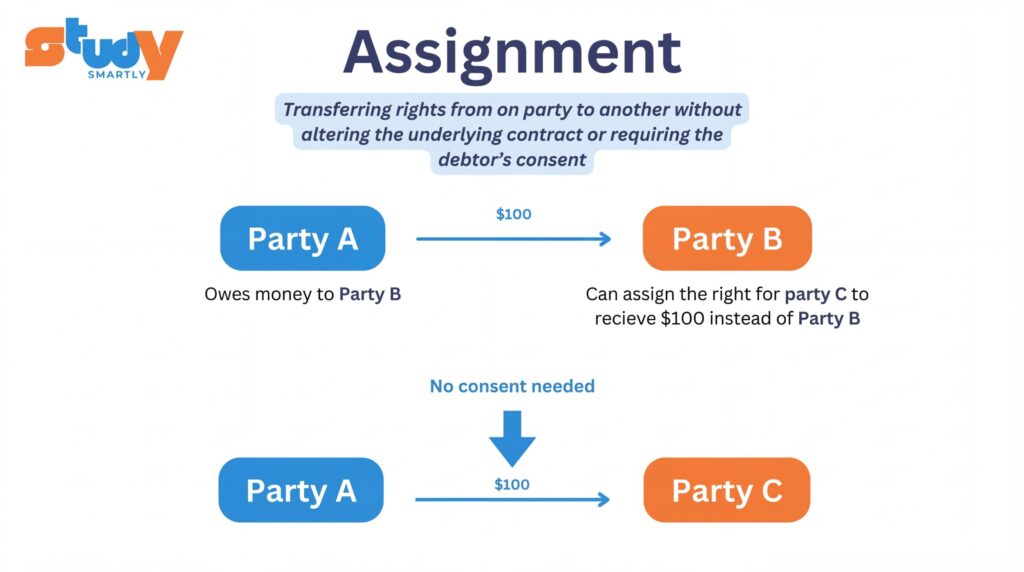
Diagram illustrating the basic flow of assignment: Assignor transfers rights to Assignee, while the original contract with the Obligor remains.
What is Assignment of Contract?
In general contract law, assignment occurs when the assignor (original party entitled to benefits) transfers their contractual rights to an assignee (third party). The assignee “steps into the shoes” of the assignor, gaining the right to enforce benefits like payments or performance.
- Rights (benefits, e.g., receiving money or goods) are typically assignable.
- Obligations (duties, e.g., performing services) are not assignable without consent, as this would impose burdens on the other party (obligor) unfairly.
Assignment does not extinguish the original contract; it merely redirects benefits. The assignor often remains liable for any pre-assignment breaches.
Example: Party A contracts with Party B for delivery of goods in exchange for payment. If A assigns the right to payment to Party C, C can demand payment from B, but the delivery obligation stays with A unless otherwise agreed.
Types of Assignment
Common classifications include:
- Legal vs. Equitable Assignment:
- Legal: Formal, often requiring writing and notice for full enforceability.
- Equitable: Based on intent and fairness, enforceable even without strict formalities.
- Absolute vs. Conditional:
- Absolute: Complete and irrevocable transfer.
- Conditional: Dependent on events (e.g., payment upon maturity).
- Voluntary vs. By Operation of Law:
- Voluntary: By party agreement.
- Involuntary: E.g., upon death or bankruptcy.
Partial assignments (transferring only some rights) are often recognized in equity but may require the assignor to join enforcement actions.
General Rules for Valid Assignment
Across common law systems, validity typically requires:
- Intention to Assign: Clear intent for absolute transfer.
- Notice to Obligor: Recommended or required for the assignee to bind the debtor directly (prevents payment to the wrong party).
- No Material Alteration: Assignment must not increase the obligor’s burden, risk, or change performance materially.
- Formality: Often in writing for enforceability, especially for significant rights.
- Consideration: Not always required; gratuitous assignments can be valid in equity.
The common law favors free assignability to promote commerce, unless restricted.
What Cannot Be Assigned?
Certain rights are non-assignable due to their nature or policy:
- Personal Contracts: Involving unique skills, trust, or confidence (e.g., employment of a specific artist or professional services).
- Prohibited by Contract: Anti-assignment clauses are generally upheld if clear.
- Public Policy Violations: E.g., personal injury claims (to discourage litigation trading) or certain future wages.
- Material Change in Risk: If assignment alters the obligor’s expected performance or value.

Assignment vs. Novation: Key Differences
A frequent point of comparison is novation, where the original contract is extinguished and replaced.
Comparison diagrams highlighting differences: Assignment transfers rights only; novation substitutes parties entirely.
| Aspect | Assignment | Novation |
|---|---|---|
| Transfer | Primarily rights (benefits) | Both rights and obligations |
| Original Contract | Remains in effect | Extinguished; new contract created |
| Original Party | Often remains liable | Fully discharged |
| Consent Required | Usually not for rights; yes for obligations | From all parties (including obligor) |
| Effect on Obligor | No change in duties | Potential new counterparty |
Example: Assignment lets a creditor transfer debt collection rights without releasing the debtor’s obligations. Novation fully substitutes a new debtor, requiring agreement.
Practical Implications and Variations
Assignment facilitates financing (e.g., factoring receivables) and business restructurings. However, enforceability varies slightly:
- Common law systems emphasize freedom of assignment with protections against material changes.
- Anti-assignment clauses are enforced but interpreted narrowly (e.g., prohibiting only delegation of duties, not rights transfer).
- Notice ensures priority and prevents double payment.
In cross-border contracts, parties often choose governing law to clarify rules, as principles align closely in common law jurisdictions but differ in civil law systems (e.g., more formal requirements).
Conclusion
Assignment provides essential flexibility in contract law by allowing transfers of benefits while preserving core obligations. Understanding its limits—personal nature, prohibitions, and distinctions from novation—helps avoid disputes. Always review contract terms for restrictions and consider formal documentation.
FAQs
Q1: Does assignment require the other party’s consent? A: Generally no for rights; yes if transferring obligations.
Q2: Can partial rights be assigned? A: Yes, often in equity, though enforcement may involve the original party.
Q3: What if the contract prohibits assignment? A: Typically unenforceable, unless waived or public policy allows.
Q4: How does assignment differ from delegation? A: Delegation shifts duties (with liability often retained); assignment focuses on rights.